
That sudden, deafening BANG from the garage is a sound no Canadian homeowner wants to hear. Your car is now trapped, your home’s security is compromised, and a wave of questions hits you: Is it safe? Who do I call? How much will this cost? This immediate stress is exactly why we’re here to help. You’re likely dealing with a broken garage door spring, a common but serious issue that requires a calm, professional response.
Before you do anything else, stop. This 5-step emergency checklist is your essential guide to navigating the next few minutes safely. We’ll show you exactly how to identify the damage, secure your home, and understand the critical next steps for a fast, reliable repair. Our mission isn’t just to fix the problem; it’s to restore your security and peace of mind without delay. Let’s get your day back on track.
Step 1: Identify the Telltale Signs of a Broken Spring
If you suspect you have a broken garage door spring, your first priority is safety. Before you do anything else, conduct a quick visual inspection from a distance. Do not touch the springs, cables, or any other part of the door mechanism. A broken garage door spring is one of the most common and dangerous garage door failures. Recognizing these clear warning signs will help you explain the issue to a professional technician, prevent further damage, and get your door fixed fast.
The Loud ‘Bang’ or ‘Pop’ Sound
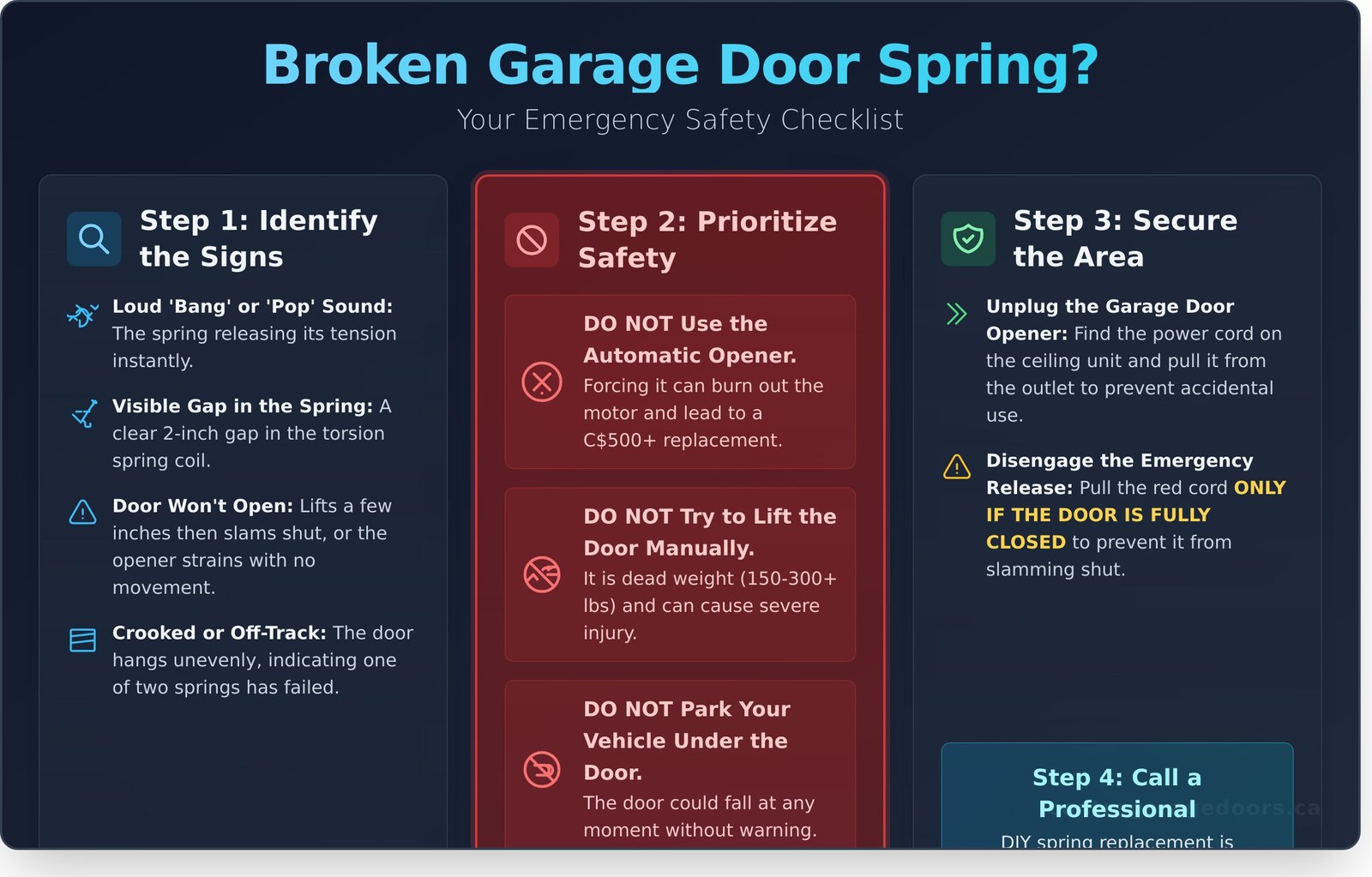
Often, the first sign of a broken spring is an incredibly loud noise that sounds like a gunshot or firecracker. This startling sound is the result of the spring, which is under extreme tension, snapping and releasing all its stored energy in an instant. This can happen at any time, day or night, whether the garage door is in motion or completely stationary.
A Visible Gap in the Spring
Take a safe look at the hardware above your closed garage door. Most residential homes in Canada use one of two main types of Garage door springs. If you have a torsion spring (a large coil mounted on a metal bar), you will see a distinct gap of about two inches in the middle of the coil where it has snapped. If you have extension springs (which run alongside the door tracks), you may see one dangling or completely broken.
The Garage Door Won’t Open
The springs do the heavy lifting, not the opener. If a spring is broken, your garage door opener won’t have the strength to lift the door’s full weight. You will likely notice one of the following:
- The door attempts to open, lifts a few inches, and then slams back down.
- The opener motor makes a humming or straining noise, but the door doesn’t move at all.
- If you disconnect the opener and try to lift the door manually, it will feel extremely heavy.
Crooked or Off-Track Door
If your system uses two springs and only one breaks, the door will lose support on one side. This causes the door to hang crookedly in the opening or even come off its tracks as the remaining spring pulls unevenly on the system. This is a critical sign of a serious problem. If your door is crooked, stop using it immediately and call for professional service to prevent a total system failure.
Step 2: Prioritize Safety – What NOT to Do
You’ve identified the problem, but what you do next is critical. Before you search for a solution, your immediate actions can prevent serious injury and costly additional damage. A garage door with a broken spring is unstable, heavy, and extremely dangerous. Follow these essential rules to keep your family, vehicle, and property safe while you wait for professional help.
DO NOT Use the Automatic Opener
It’s tempting to hit the button, but your automatic opener is not designed to lift the full weight of the door-that’s the springs’ job. Forcing the opener to lift hundreds of pounds of dead weight can strip its gears, burn out the motor, or snap the drive chain. This common mistake can quickly turn a straightforward spring repair into a costly C$500+ opener replacement.
DO NOT Try to Lift the Door Manually
Without the counterbalancing force of the springs, your garage door is dead weight, often tipping the scales at 150 to over 300 pounds. Attempting to lift this on your own is a direct path to severe back injury. Worse, if the door slips or the second spring fails under the unbalanced load, it can slam shut, causing life-threatening injury. The immense tension involved is why professionals must adhere to strict DASMA safety standards during service.
Clear the Area and Secure the Scene
Treat your garage door as an active hazard until it’s professionally repaired. A broken garage door spring means the door is unpredictable. Your first priority is to create a safe zone.
- Keep children and pets far away from the garage area.
- Explain the danger to all family members so no one attempts to use the door.
- Do not park your vehicle under the door, even if it’s only partially open. It could fall at any moment without warning.
Securing the area ensures that a preventable accident doesn’t happen while you arrange for a certified technician.
Step 3: Secure the Door and Disconnect Power
Once you’ve confirmed you have a broken garage door spring, your immediate priority shifts to safety. Before a technician can arrive, you must secure the area to prevent any accidental use of the door, which could lead to further damage or serious injury. These crucial steps only take a few minutes but are non-negotiable for protecting your family and your property. Before any professional garage door repair work begins, creating a safe environment is essential, a core principle advocated by industry leaders like the International Door Association (IDA).
Taking these precautions ensures the situation is stable and ready for a certified technician to take over. Do not skip this step.
Unplug the Garage Door Opener Unit
The single most important safety action you can take is to cut power to the garage door opener. Attempting to operate the door with a remote or wall switch when a spring is broken can cause the opener motor to strip its gears, bend the rails, or damage the door panels. It is an expensive mistake that is easily avoided.
- Locate the Motor: Look up at the garage door opener unit mounted on your ceiling.
- Find the Power Cord: Trace the black power cord from the unit to the electrical outlet it’s plugged into.
- Unplug It: Firmly pull the plug from the outlet. This completely removes the risk of accidental activation.
Disengage the Emergency Release Cord (If Necessary)
Your garage door opener has a red cord with a handle hanging from the motor’s track. This is the emergency release, which disconnects the door from the automated opener, allowing for manual operation. However, you must use it with extreme caution.
IMPORTANT: Only pull the emergency release cord if your garage door is fully in the DOWN position. If you disengage the opener while the door is open, the full weight of the door will no longer be supported. Without a functioning spring to counteract gravity, the door will slam shut with dangerous force. Pulling the cord on a closed door simply prepares it for our technician to safely lift and service it manually upon arrival.
Step 4: The Dangers of DIY Spring Replacement
When faced with a broken garage door, the temptation to order parts online and attempt a DIY repair is understandable. A quick search might show potential savings of a couple of hundred dollars. However, replacing a broken garage door spring is not like fixing a leaky faucet; it is one of the most dangerous home repairs a person can undertake without professional training. The risks involved far outweigh any potential cost savings. This is one job that must be left to certified technicians.
Extreme Tension and Unpredictable Risk
Garage door springs are under an immense amount of tension-enough to lift a door weighing hundreds of pounds. If this tension is released improperly during removal or installation, the spring or related components can become dangerous projectiles. A snapping cable or a flying winding bar can cause severe lacerations, broken bones, eye damage, or worse. The stored energy in these springs is powerful and extremely unpredictable for the untrained hand.
Specialized Tools are Required
A safe spring replacement requires specialized tools, most importantly a pair of high-tensile steel winding bars. A common and tragic mistake is attempting to use screwdrivers, crowbars, or pieces of rebar. These tools are not designed to handle the torque required to wind a spring and can easily slip or break, leading to catastrophic injury. Our professional technicians arrive equipped with the correct, calibrated tools to adjust the tension safely and precisely every time.
Installing the Wrong Spring
Not all garage door springs are created equal. They must be perfectly matched to your door’s specific weight, height, and size. Installing the wrong spring-even one that looks similar-will throw the entire system out of balance. This will put immense strain on your garage door opener, causing it to burn out prematurely, and can even lead to further damage to the door panels and tracks. A professional ensures the exact right part is used for safe, long-term performance.
Don’t risk your safety or the integrity of your garage door system to save a few dollars. The potential for injury and more costly future repairs is simply too high. Call our certified technicians for safe, same-day service. We have the tools, training, and experience to handle the job correctly and restore your peace of mind.
Step 5: Call a Professional for Fast, Safe Repair
A broken garage door spring is more than an inconvenience; it’s a security risk and a serious safety hazard. While DIY solutions might seem tempting, the immense tension in garage door springs makes professional repair the only safe option. The fastest and most reliable solution is to call a trusted technician. In about an hour, a certified professional can have your door operating smoothly again, restoring your home’s security and your peace of mind.
Knowing what to expect when you make the call will ensure the process is smooth, transparent, and stress-free.
What to Ask When You Call
When you contact a garage door repair company, you need clear, direct answers. Being prepared with the right questions ensures you hire a reputable professional. Here’s what to ask:
- Is your company licensed and insured? This is non-negotiable. It protects you and your property from any potential liability.
- Do you offer same-day service in the GTA? When your car is stuck, you can’t wait. Confirm their ability to provide urgent repairs.
- What is the estimated cost? Ask for a quote that includes parts, labour, and any service call fees to avoid surprises.
- Do you provide a warranty? A quality company will stand behind their work with a warranty on both the new springs and their installation.
The Professional Repair Process
Understanding the repair process can help ease any anxiety. A certified technician follows a strict safety protocol to handle your broken garage door spring and get your door back in service quickly. You can expect them to:
- Arrive with the correct high-quality torsion or extension springs for your specific door model and weight.
- Safely release any remaining tension from the system and carefully remove the broken spring components.
- Install the new spring(s) and wind them to the precise tension required for balanced and smooth operation.
- Perform a full balance test, check safety features, and lubricate all moving parts to ensure peak performance.
Why Choose Contra Garage Doors?
When you’re facing a garage door emergency, you need a team you can count on. At Contra Garage Doors, we don’t just fix problems-we deliver reliable solutions. We are the trusted choice for homeowners across the GTA because:
- We offer a same-day service guarantee. No excuses. We understand the urgency and promise to be there when you need us most.
- Our technicians are certified, insured, and highly experienced. They have the expertise to handle any spring repair safely and efficiently.
- We provide upfront, transparent pricing. You’ll receive a clear, honest quote before any work begins, with absolutely no hidden fees.
Your car is trapped? Call now for urgent garage door spring repair.
Your Next Step for a Fast, Safe Repair
When you’re facing a garage door emergency, the most critical takeaways are to prioritize safety above all else. Never attempt to operate the door or perform a DIY repair, as the high tension in the system poses a serious risk. The most important step is to secure the area and contact a certified professional immediately.
Dealing with a broken garage door spring is a major disruption, but the solution can be simple and immediate. For homeowners across Toronto and the entire GTA, Contra Garage Doors delivers on our promise of a Same-Day Service Guarantee. Our certified and insured technicians will arrive promptly to restore your garage door’s function and your home’s security, no excuses.
We don’t just fix the problem; we upgrade your peace of mind. Need a fast and reliable fix? Call Contra for same-day spring replacement! Let us handle the heavy lifting so you can get back to your day, worry-free.
Frequently Asked Questions About Broken Garage Door Springs
How much does it cost to replace a broken garage door spring in Toronto?
In the Greater Toronto Area, the cost for a professional garage door spring replacement typically ranges from C$250 to C$450. This price includes the new spring(s) and the labour from a certified technician. The final cost can vary based on the type of springs your door uses (torsion vs. extension) and the door’s size and weight. We provide clear, upfront pricing before any work begins, ensuring there are no surprises and you get a fair, competitive rate.
Should I replace both garage door springs if only one is broken?
Yes, we strongly recommend it. Garage door springs work in tandem and have the same lifespan. If one spring has broken from use, the other is likely to fail soon. Replacing both at once is more cost-effective as it saves you from a second service call. More importantly, it ensures your garage door is properly balanced, which reduces strain on your opener and is crucial for safe, reliable operation. It’s a small investment for long-term peace of mind.
How long does a garage door spring replacement take?
A professional spring replacement is a fast and efficient process. For a certified Contra Garage Doors technician, the job typically takes between 30 and 60 minutes. Our experts arrive with fully-stocked trucks containing the right tools and a wide variety of high-quality springs to fit your specific door. This preparation allows us to complete the repair quickly and safely in a single visit, restoring your garage door’s function with minimal disruption to your day.
What’s the difference between torsion and extension springs?
The two main types of springs perform the same function but are mounted differently. Torsion springs are located on a metal bar directly above the closed garage door and work by twisting. They are generally safer, more durable, and provide better balance. Extension springs are found on both sides of the door, running parallel to the horizontal tracks. They work by stretching and contracting. Our technicians can quickly identify your system and provide the correct service.
Can I open my garage door with a broken spring to get my car out?
We strongly advise against it. Without a functioning spring, your garage door’s entire weight-often hundreds of pounds-is unsupported. Attempting to lift it manually is extremely dangerous and can lead to serious injury. Using the automatic opener can also cause severe damage to the motor and tracks. Your safety is the top priority. Please call a professional immediately; we offer same-day emergency service to get your door open safely and get you on your way.
How long do garage door springs typically last?
Standard garage door springs are rated for about 10,000 cycles, with one cycle being a full opening and closing of the door. For the average household, this translates to a lifespan of 7 to 12 years. Factors like heavy usage, extreme Toronto weather, and lack of maintenance can shorten this period. Investing in high-cycle, durable springs during a replacement can extend this lifespan significantly, delaying the next time you have to deal with a broken garage door spring.